
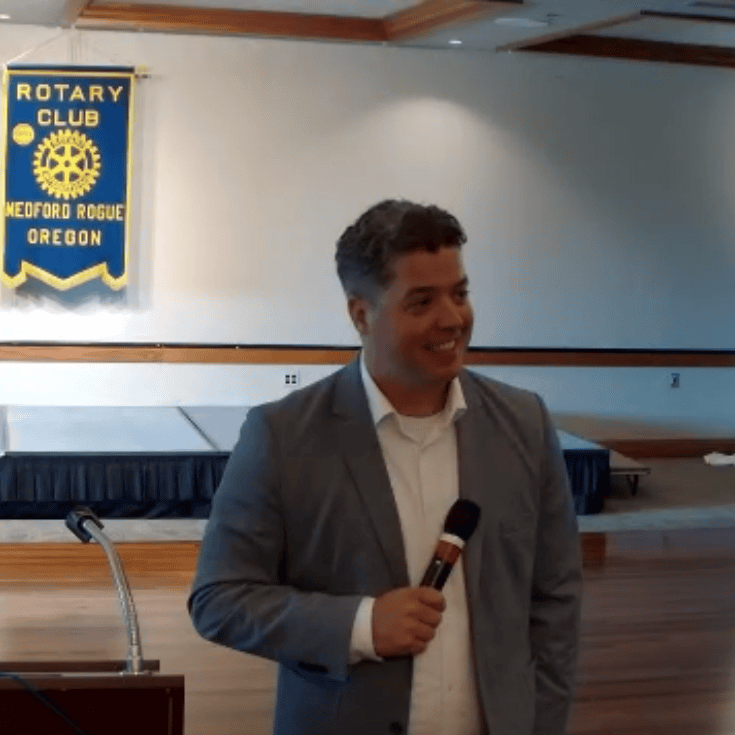
Program: What BASO Does, and Why the Work Matters
Speaker: Dr. Joey Minear, CEO
Builders Association of Southern Oregon
Program Introduction: Claudette Moore
Meeting Location: Rogue Valley Country Club, 2660 Hillcrest Rd, Medford, OR 97504
Meeting Recap
Our Medford Rogue Rotary program featured Dr. Joey Minear, CEO of the Builders Association of Southern Oregon (BASO), who shared an overview of the organization, current housing and construction trends, and why a healthy building industry is important to the economic strength and quality of life of Southern Oregon.
BASO is a regional building-industry association serving Jackson, Josephine, Coos, and Curry counties and representing builders, contractors, suppliers, and other businesses connected to the construction industry. BASO works to connect the local industry with state and national resources while providing education, advocacy, networking, and business support. (Builders Association Southern Oregon)
BASO at a Glance
 Minear shared some of the history and scope of the organization:
- BASO traces its roots to 1965, when it began as the Jackson County Home Builders Association.
- Following a district restructuring, it became BASO in 2016.
- The association currently represents approximately 262 members throughout the region.
- Its four-county territory includes Jackson, Josephine, Coos, and Curry counties.
BASO connects local builders, contractors, suppliers, and industry partners with resources available through the Oregon Home Builders Association and National Association of Home Builders.
More Than Building Houses
A central theme of Minear’s presentation was that construction is about much more than individual projects. The strength of the building industry directly affects the capacity and health of a community.
Among the areas influenced by a strong construction industry are housing availability, small-business stability, the skilled workforce, public policy, community resilience, and housing affordability.
Builders and trade contractors are also local employers, taxpayers, sponsors, and community problem-solvers. At the same time, good housing policy benefits from the involvement of people who understand what actually happens on job sites—including construction timelines, costs, permitting, and code compliance.
Jackson County Construction Trends
Minear highlighted recent Jackson County housing data showing an increase in new housing units permitted, from approximately 896 units in 2024 to 944 in 2025.
The important distinction, however, is that more permits do not necessarily translate into easier or more affordable housing production.
Project feasibility continues to be affected by construction costs, financing, land availability, infrastructure and utilities, and development-review timelines. BASO sees an important part of its role as identifying these bottlenecks and bringing industry and community leaders together to develop practical solutions.
Oregon’s Housing Production Challenge
The presentation also placed Southern Oregon’s experience within Oregon’s larger housing challenge. Minear cited a statewide production goal of approximately 36,000 new housing units annually, compared with roughly 14,960 new units permitted in 2025.
The gap illustrates that simply establishing housing goals is not enough. Land availability, infrastructure capacity, financing, permitting processes, and other practical constraints ultimately determine whether proposed housing can actually be built.
The Housing Mix Is Changing
Another trend highlighted during the presentation was the growing importance of smaller and more attainable housing formats.
Minear noted national data showing townhouses accounting for approximately 18.4% of single-family housing starts in the fourth quarter of 2025. She also discussed multifamily construction and the increasing importance of attached and smaller-format housing where land, infrastructure, and affordability present challenges.
The broader takeaway was that meeting future housing needs may require communities to accommodate a wider variety of housing types rather than relying primarily on traditional detached single-family development.
What BASO Brings to the Industry
Minear described six practical ways BASO supports Southern Oregon’s building community:
- Build Connections — Bringing builders, tradespeople, suppliers, and industry partners together throughout the region.
- Grow Your Business — Providing education, resources, savings programs, and member benefits that help local businesses succeed.
- Make an Impact — Giving the building industry a voice in discussions involving housing, permitting, building codes, and public policy.
- Stay Informed — Sharing regulatory information, advocacy updates, industry news, and market trends affecting members.
- Support and Belong — Creating a community where members can share successes, solve problems, and support one another.
- Create Memorable Experiences — Hosting events and opportunities where members can connect, learn, and celebrate together.
- BASO’s broader work includes continuing education, industry advocacy, networking, community events, and workforce-development efforts. The organization says it participates in more than 100 meetings annually with government and regulatory organizations at the national, state, regional, and local levels.
Key Takeaway
Minear closed with a straightforward explanation of BASO’s purpose: helping Southern Oregon build better.
That means tracking construction trends so decisions can be based on data rather than assumptions; advocating so builders and contractors have a seat at the table when housing policy is developed; educating industry professionals with practical information; and supporting workforce development because Southern Oregon cannot increase housing production without skilled people to do the work.
The presentation offered Rotarians a useful reminder that housing, workforce development, small-business health, infrastructure, and economic development are closely connected. Addressing Southern Oregon’s housing challenges will require collaboration among builders, government, community organizations, businesses, and residents—and BASO is working to help bring those groups together.
Watch the meeting recording
