
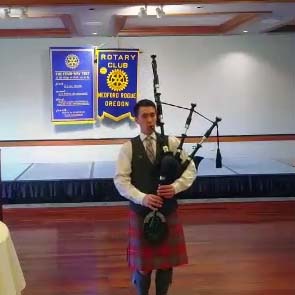
Program: A Luncheon with Bagpipes
Program Description: Gavin will talk about his brief history with bagpipes and then play a couple of tunes. He has competed in Canada, the East Coast and all over the west.
Speaker: Gavin Guidotti, Student at Logos
Program Introduction: Grandpa Rick Clark
Meeting Location: Rogue Valley Country Club, 2660 Hillcrest Rd, Medford, OR 97504
Meeting Recap
Rick Clark introduced his grandson Gavin Guidotti, a competitive bagpiper who has been playing since age 5. Gavin delivered a live performance and educational demonstration for the club, explaining the mechanics of the Great Highland bagpipes and sharing his personal journey as a musician.
Gavin’s Background
Gavin was inspired to play bagpipes at age 5 after seeing pipers in Ashland. He was mentored by local community members Becky and Don, joined the Jefferson Pipe Band, and began competing nationally by age 10. He trained with Scottish masters in Washington and progressed rapidly through skill levels 5 to 1 — a pace described as exceptional, as Level 4 stops approximately 70% of players. He has competed in Chicago, Florida, Canada, and Los Angeles, earning numerous prizes.
Bagpipe Mechanics Explained
- Chanter: The primary melody-producing component, made of blackwood in Gavin’s set. It is the source of all musical notes.
- Bag: Made of sheepskin, it stores air so the player can maintain continuous sound without pausing to breathe. Synthetic bags also exist, but sheepskin is preferred for its resonance.
- Drones: Two tenor drones (higher pitch) and one bass drone harmonize with the chanter. Drone reeds are now typically synthetic rather than cane.
- Tuning: Bagpipes require constant tuning via sliding drone components and are considered highly finicky instruments.
- Cost: A basic set costs approximately $1,500, but prices rise quickly with aftermarket chanters ($500), premium bags ($500), and decorative materials.
Tunes Performed
- Skyboat Song (from the television series Outlander)
- Jigs (traditional Highland dance tunes)
- Hector the Hero (a slow air)
- Manson’s Apron (a personally adapted version)
- Thunderstruck (AC/DC, performed by popular request)
Relevant Q&A
- Question: Do bagpipers always march while playing?
- Answer (Gavin): Yes, marching is deeply embedded in bagpipe culture, originating from the tradition of pipers leading Scottish troops into battle. There are specific march types, including retreat marches and advance marches.
- Question: Is there written sheet music for bagpipes, and do band members play different parts?
- Answer (Gavin): Sheet music exists, but it must be memorized for performance. Band members typically play the same melody together, though harmonies are sometimes incorporated.
- Question: How do players build lung capacity?
- Answer (Gavin): Beginners start on a practice chanter (similar to a recorder) and gradually build up. Early practice involves corking the drones to reduce air resistance, allowing players to develop stamina incrementally.
- Question: Do all bagpipes have three drones?
- Answer (Gavin): Great Highland bagpipes consistently feature three drones (two tenor, one bass). Other bagpipe varieties exist but were noted as a separate topic.
- Question: What else does Gavin do besides bagpiping?
- Answer (Gavin): Gavin is a senior in high school, taking dual-credit college courses at RCC, and plans to become an electrician. He also ballroom dances and snowboards.
Watch the meeting recording
