
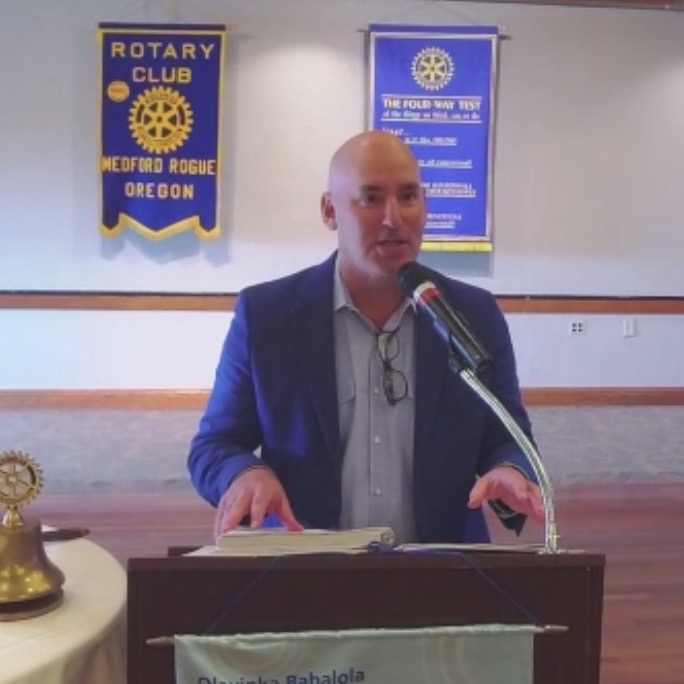
Program: Economic Impact of Medford Recreation Facilities
Program Description: Statistics and trends in sports team use of facilities as they relate to economic stimulus.
Speaker: Rich Rosenthal, Parks and Recreation Director
City of Medford
Program Introduction: Claudette Moore
Meeting Location: Rogue Valley Country Club, 2660 Hillcrest Rd, Medford, OR 97504
Meeting Recap
Our presentation was by Rich Rosenthal, Director of Parks and Recreation for the City of Medford. The presentation focused on the economic impact of three major City of Medford recreation facilities: Lithia Driveway Fields (sports park), the Rogue Credit Union Community Complex (Rogue X), and The Courts by Lithia and Driveway (pickleball facility).
Key Concepts or Theories
- Economic stimulus generated by visitor spending at public recreation facilities
- Cost recovery model for publicly subsidized recreation facilities
- Ripple effect multiplier (1.85x) applied to total spending to estimate overall economic impact
- Strategic use of recreation infrastructure to attract tournaments and offset economic downturns
- Naming rights agreements as a funding mechanism for public facilities
Important Questions Raised
- What is the future vision for parks and recreation development in Medford over the next 5 to 10 years?
- How does the department manage maintenance and logistics across its extensive park system?
- How will the upcoming Jackson County Peak Performance Center at the Expo interact with existing City of Medford recreation facilities?
- Is there potential for Masters swimming programs and U.S. Swimming certification at the Rogue X?
Key Takeaways and Summary of Learning Objectives
- The City of Medford operates 29 developed parks, over 2,500 acres of parkland, and 45 miles of trails, with an operating budget of nearly $13 million.
- Medford is one of only 232 nationally accredited parks and recreation agencies out of approximately 14,000 in the United States.
- Lithia Driveway Fields generated nearly $13 million in economic stimulus in 2025, its second-best performance ever, and has produced over $78 million in visitor spending since opening in May 2008.
- The Rogue X generated an estimated $9.8 million in economic impact in 2025, up from $6.7 million in 2024, bringing its two-year total to approximately $16.5 million.
- Combined, the sports park and Rogue X generated $23.1 million in estimated economic impact in 2025 and over $200 million since 2008.
- Visitor spending — from out-of-town teams, tournament participants, and event attendees — is identified as the primary economic driver of these facilities.
- The department uses a 1.85x multiplier on total spending to estimate overall economic stimulus, accounting for the ripple effect of local economic activity.
- Demand for baseball and softball tournaments significantly exceeds current field capacity, with 206 spring tournament slots selling out in under five minutes.
Topic 1: Lithia Driveway Fields — Sports Park Economic Impact
Lithia Driveway Fields, originally known as the Medford Sports and Community Park, is a 15-field outdoor sports complex built between 2006 and 2013 for $32.5 million. It opened in May 2008 and is now in its 19th year of operation. The facility was made possible in part through the advocacy of former City Councilor Claudette and the financial stewardship of City Manager Brian Schotun, who secured one of the largest naming rights deals in Oregon history — first with U.S. Cellular and subsequently with Lithia, which recently renewed for a second five-year term at $150,000 per year.
In 2025, the park hosted 46 tournaments and events — the second-highest total in its history — attracting nearly a quarter million visitors. Over its 19-year history, the park has recorded over 3.5 million visits. Tournament teams were nearly evenly split between local and visiting teams, underscoring the facility’s role as both a community asset and a regional economic driver.
Notable 2025 highlights include a record 339 girls fast-pitch softball teams, a record 19 adult slow-pitch softball tournaments, and 373 youth baseball teams competing across 10 city-run tournaments. The 2025 economic stimulus came within $106,000 of the record set in 2024, marking only the third time the park exceeded $13 million in annual economic impact. Since opening, the facility has generated an estimated $78 million in visitor spending alone.
Relevant Q&A
Question: “What is the future vision for parks and recreation, particularly regarding field capacity and park development over the next 5 to 10 years?”
Answer: Rich Rosenthal noted that the department does not have enough fields to meet current demand, citing spring baseball tournaments that sell out 206 slots in under five minutes. Future priorities include building or improving existing facilities, a potential partnership with Medford National Little League, consideration of a new baseball stadium at Hawthorne Park (being reviewed by City Council), expansion of the pickleball facility by 6 additional courts, a new 4-court sand volleyball facility, and potential installation of artificial turf at Fagoni Field in Jackson Park to increase all-weather capacity and tournament hosting ability.
Topic 2: Rogue Credit Union Community Complex (Rogue X) — Indoor Recreation and Economic Impact
The Rogue X is a 140,000-square-foot indoor recreation center that opened on January 6, 2024. The facility cost approximately $76 million to build and serves as a highly versatile community hub hosting trade shows, car shows, basketball and volleyball tournaments, aquatic programs, and more. In 2025, the facility hosted 65 scheduled events, up from 54 in its first year, and attracted an estimated 300,000 visitors.
Key 2025 highlights include 474 teams competing in 11 basketball tournaments, 176 volleyball teams, over 105,000 visits to the aquatic facilities, and a nearly 15% increase in event center drop-in usage. The department noted that usage numbers for 2025 may exceed those of the facility’s first year, defying the typical post-novelty decline. The Rogue Rapids competitive swim team has grown to 130 members in under three years and is achieving state-level results.
A school-to-pool water safety program was launched in partnership with the Medford School District, targeting all 40 fourth-grade classrooms in the district, funded through the Rogue Credit Union naming rights agreement. The Rogue X costs $2.5 million per year to operate, with direct revenue of approximately $1.4 million, yielding a 54% cost recovery rate. The remaining subsidy comes from the general fund and is considered offset by the facility’s economic impact.
Looking ahead, the Rogue X will host the World Championship Cornhole event from July 22 to 31, anticipated to draw as many as 2,000 competitors from around the world.
Relevant Q&A
Question: “How do you manage the maintenance and operating costs of these facilities?”
Answer: Rich Rosenthal explained that the Rogue X costs $2.5 million annually to operate, with approximately $1.4 million recovered through direct revenue (54% cost recovery). The remaining subsidy is drawn from the general fund. The department believes this subsidy is justified and is offset by the $16.5 million in estimated economic impact over the facility’s first two years of operation.
Question: “Are there any international events on the horizon for the Rogue X?”
Answer: Rich Rosenthal confirmed that the Rogue X will host the World Championship Cornhole event from July 22 to 31, expected to attract up to 2,000 competitors from around the world. This event would not be possible without the facility.
Question: “Is there potential for Masters swimming and U.S. Swimming certification at the Rogue X?”
Answer: Rich Rosenthal acknowledged that Masters swimming is a recognized opportunity for the future. The department’s current focus has been on establishing facility operations and supporting the growth of the Rogue Rapids competitive swim team, but Masters swimming remains on the horizon.
Question: “How will the upcoming Jackson County Peak Performance Center at the Expo interact with City of Medford recreation facilities?”
Answer: Rich Rosenthal stated that he does not yet have enough information to answer this question meaningfully, as the county has only recently begun hiring staff for the facility. He asked to be revisited on this topic in approximately one year.
Topic 3: The Courts by Lithia and Driveway — Pickleball Facility and Economic Impact Methodology
The Courts by Lithia and Driveway is the largest outdoor pickleball facility in the state of Oregon, featuring 19 courts located adjacent to the Rogue X. The facility hosted two major tournaments in 2025: the Summer Classic in June, organized by the Southern Oregon Pickleball Association, and a Pickleball Fest in August, co-organized with the Rotary Club.
Rich Rosenthal used the Summer Classic as a case study to explain the department’s economic impact methodology. The tournament drew 277 participants, of whom 50 (approximately 18%) were visitors from outside the Rogue Valley. Local spending was calculated based on registration fees and estimated meal expenditures. Visitor spending assumed hotel stays and meals in Medford for the 50 out-of-town participants, estimated at approximately $23,000. Total combined spending for the tournament was approximately $43,000. Applying the 1.85x ripple-effect multiplier, the estimated overall economic stimulus from the tournament was approximately $79,550.
Rich Rosenthal acknowledged that the multiplier is a subject of debate in the field — some argue it understates impact, while others contend it inflates figures. The department bases its methodology on established industry literature and updates its data annually through participant surveys.
Relevant Q&A
Question: “What is the methodology behind the economic impact figures, and how reliable are they?”
Answer: Rich Rosenthal explained that the department collects survey data from tournament participants to estimate local and visitor spending. A 1.85x multiplier is then applied to total spending to account for the ripple effect — the secondary economic activity generated when visitors and service workers spend money within the local economy. He acknowledged the multiplier is debated in the field. Still, he noted that the visitor-spending component alone is a conservative and defensible figure, since those dollars would not exist in the local economy without the facility.
Watch the meeting recording
